


The first quarter of FY27 for the top-tier Indian IT sector was defined by a delicate balance: while aggregate revenues showed signs of stabilization with a marginal 0.1% sequential uptick, the period was marked by divergent vertical performances and a strategic shift in workforce management. Management commentary across the industry reveals a landscape where AI-led transformation is simultaneously a revenue driver and a productivity lever, even as macroeconomic headwinds persist.
Deep dive: Key performance parameters and management rationale
- Financial performance: Stabilization & strategic resilience
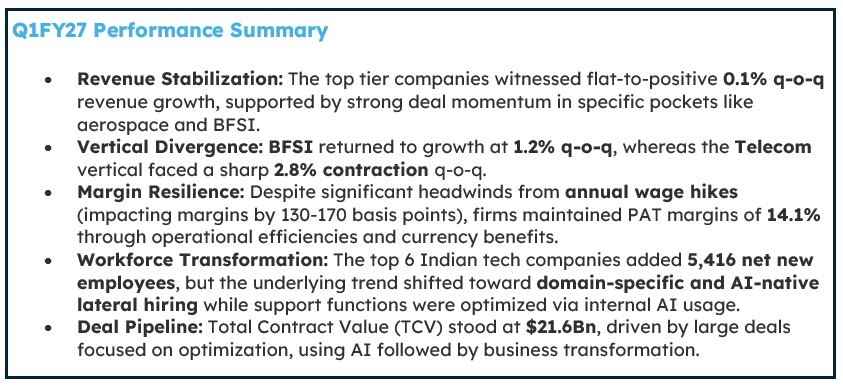
- Revenues grew by 0.1% q-o-q, a critical stabilization after a -0.1% dip in the preceding quarter. This recovery was supported by growth in sectors like BFSI and Manufacturing, alongside the steady ramp-up of large deals signed in previous periods.
- Net margins moderated marginally to 14.1%, down from 14.3% in Q4FY26. This expected compression was primarily driven by the annual salary increment cycle, which acted as a significant headwind, impacting margins by as much as 130 to 170 basis points.
- Deals TCV for the quarter stood at $21.6 Bn, down from $23.3 Bn in the previous quarter. Despite the lower aggregate volume, management highlighted a qualitative shift in the deal mix. While the environment for traditional cost-optimization and vendor consolidation remains intensely competitive, there is growing momentum in AI-led business transformation deals.
- Workforce dynamics and productivity: Strategic realignment
- Net Addition: After a sharp contraction in the previous quarter (-7,148), the industry added 5,416 net new employees in Q1FY27, a 0.3% growth.
- Management commentary indicated that while overall hiring is positive, the nature of recruitment has changed. Firms are increasingly prioritizing domain-specific and AI-native lateral talent, with some leaders reporting that over 50% of new lateral hires possess next-generation skills.
- Attrition: Remained largely stable at 13.1% in Q1FY27 and is described by management as being at “comfortable” and “stable” levels. The focus has shifted from merely retaining staff to massive upskilling.
- Revenue Per Employee: Revenue per employee held steady at its peak sequentially, reflecting a 0.3% increase y-o-y.
- Management attributes this sustained efficiency to AI-enabled automation and improved “tooling” in fixed price projects. By using AI to handle standard coding and testing, firms are able to deliver more value with the same headcount, allowing them to repurpose existing employees to new engagements.
- Net Addition: After a sharp contraction in the previous quarter (-7,148), the industry added 5,416 net new employees in Q1FY27, a 0.3% growth.
- Vertical performance: Selective growth engines
- BFSI (+1.2% q-o-q): Growth was driven by an AI-native approach and increased wallet share in large accounts. Demand was healthy in payment modernization, wealth platforms, and regulatory compliance.
- Manufacturing & Hitech (+0.1% q-o-q): This vertical saw an uptick in aerospace demand and the execution of large automotive programs. However, softness persists in certain segments due to EV recalibration, supply chain resilience concerns, and tariff pressures.
- Communications & Telecom (-2.8% q-o-q): The vertical remained under pressure as global telecom operators continued to rationalize tech spending and defer discretionary transformation initiatives. Demand remained focused on cost optimization, network modernization and operational efficiency, resulting in softer revenue growth across the sector.
- Retail (-0.8% q-o-q): The vertical remained under pressure as geopolitical uncertainty and evolving tariff dynamics dampened consumer demand and delayed discretionary spending. Clients prioritized investments in supply chain resilience, inventory optimization, AI-driven customer engagement and operational efficiency over large-scale transformation initiatives.
- Geographic trends: Domestic recovery and Western stasis
- North America (0.02% q-o-q): Growth remained largely flat as enterprises maintained cautious discretionary spending and longer decision cycles. While BFSI and technology showed early signs of recovery, weakness in telecom and continued pressure in healthcare weighed on overall performance.
- EMEA (+0.05% q-o-q): The region remained stable, supported by mega-deal ramp-ups and sustained demand across automotive and aerospace. Management also identified Europe as a key growth market, backed by sovereign AI initiatives and an expanding large-deal pipeline.
- India (+2.5% q-o-q): India emerged as the fastest-growing geography, driven by public sector modernization and government-led digital transformation. Strong demand for sovereign AI and domestic infrastructure continued to build, although project ramp-ups were temporarily impacted by hardware supply constraints linked to geopolitical disruptions.